
Naga Republic News
June 12 | 2025
A Naga delegation consisting of leaders and elders of several Naga tribe hohos along with members of the Forum for Naga Reconciliation (FNR) and team volunteers of Recover, Restore and Decolonise Group (RRaD) are currently in the United Kingdom to dialogue and explore paths with the Pitts Rivers Museum, Oxford for ‘the return and future care’ of Naga ancestral human remains. The Pitt Rivers Museum in Oxford holds the largest collection of Naga material in the world, much of which was collected by colonial administrators in the early 20th century.

From Sunday 8 June to Saturday 14 June 2025 the Museum will be hosting the Naga delegates. According to a press communiqué issued by Pitt Rivers Museum dated June 10, the ongoing visit builds on community dialogue and participatory research done in the Naga homelands by the RRaD team, assessing community responses on the ancestral remains held in Oxford.
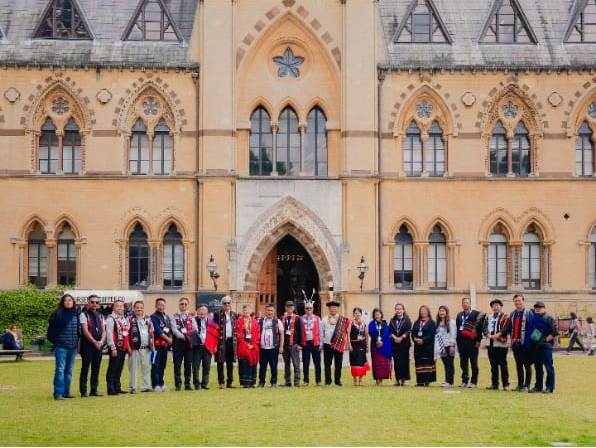
The Naga delegation at Oxford, UK
It was disclosed that discussions will focus on the repatriation of the 41 Naga ancestral remains held in the collections of the Pitt Rivers Museum, plus the future of Naga collections more broadly.
Altogether, there are 219 items in the collection which are listed as Naga human remains; these consist of 41 Naga ancestral human remains and 178 objects that contain or may contain human hair. The Naga-led dialogue will explore paths to return and future care, the press communiqué stated.
This initiative came about after Naga anthropologist, Professor Dolly Kikon, reached out to the Museum’s Director, Professor Laura Van Broekhoven, after reading widespread press reports about the decision in 2020 to remove all human remains from display, many of which were Naga.
It was informed by Pitt Rivers Museum that “after reconnecting with the ancestral remains”, the delegation will collaborate with museum staff by co-working and co-learning, discussing how the museum cares for ancestors, looking at the returns process and discussing the way forward.
The visit will conclude on Friday 13 June with a public session to be held in the Oxford University Museum of Natural History Lecture Theatre.
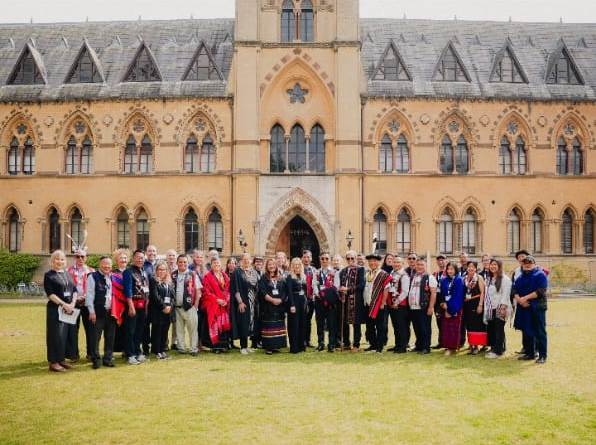
Speakers will include Professor Dolly Kikon (University of California, Santa Cruz), Dr Vihuto Asumi (President, Sumi Hoho), Dr Ellen Konyak Jamir (RRaD), Dr Aküm Longchari (FNR), Professor Arkotong Longkumer (University of Edinburgh) and Professor Laura Van Broekhoven (Pitt Rivers Museum).
There will be an opportunity to engage in conversation following the speakers. It was informed that this session will be followed by a closing ceremony with prayers and song, and a reception supported by the Centre of South Asian Studies, University of California Santa Cruz, as part of their international engagement on Indigenous justice and care initiative.
Quotes:
“This is a momentous time for the Naga people. Our ancestors travelled thousands of miles away from home, ending up in glass cages for the world to see. Now we are called as witnesses to their lives, and to understand the culmination of events that brought them to the museum. We are here not only to witness, but to remind ourselves of the potential for reconciliation and healing and to carve a better pathway for the future”.
Professor Arkotong Longkumer, University of Edinburgh
“This is not just a visit for the Naga delegation. It is an act of healing, of returning sovereign decision making, and reclaiming the dignity of our ancestors and the Naga people. For the Naga people, this partnership with the Pitts Rivers Museum is crucial to address the colonial violence and rewrite the labels museums have imposed on the Naga’s past as primitives, savages and head-hunters. Our ancestral remains, including the material artefacts at this museum, must move beyond institutional understandings of property and conservation. It is through such partnerships grounded on mutual trust and respect to listen and dialogue between museums and Indigenous communities that we can work towards healing and restoring the task of redress, care, custodianship.”
Professor Dolly Kikon, University of California, Santa Cruz
“Our ancestral remains deserve a dignified homecoming, as the concept of homeland holds deep significance. This act of return is intertwined with identity, culture and sacredness. We must uphold the sacredness of human life by honouring the dead and respecting the living. While we cannot undo the past, we can learn from it. We are engaged in a process that calls for a courageous, collective re-imagination and a commitment to truth and the labour of repair.”
Rev Dr Ellen Konyak Jamir, Recover Restore and Decolonise
“Today, as we come to visit the remains of our ancestors, our hearts are filled with grief and we are in anguish for the humiliation that our ancestors were subjected to, even after death. But we take comfort in the fact that these remains of our ancestors have stood here in Pitt Rivers Museum for many years, silently proclaiming the history of the Nagas.”
Thejao Vihienuo, President of Angami Public Organisation
“We know that this week will be one that we will feel grief and sadness when looking back on the past, but we will also feel hope as we work towards reconciliation and healing in the future. I hope we can support and hold each other throughout this process.”
Professor Laura Van Broekhoven, Pitt Rivers Museum
About the Pitt Rivers Museum
The Pitt Rivers Museum is one of the leading museums of anthropology and archaeology in the world. Part of the University of Oxford, it was established in 1884 and now stewards over 700,000 objects in the collections, including photographs, manuscripts and films. The Museum, which welcomed over 500,000 visitors in 2024, carries out world-leading conservation and research and is renowned for its innovative public programmes and collaborative work with both local and global communities. Recognised for its pioneering work engaging with its colonial past, the Museum is a much-loved Victorian space, challenging old perceptions, inspiring new audiences and building lasting relationships, demonstrating the vital role museums can play in contemporary society.
Press Contact: Louise Hancock, Head of Marketing and Press press@prm.ox.ac.uk | 01865 613017 | 07553433635
About the RRaD
Recover Restore and Decolonise (RRaD) was formed in 2021 to facilitate and engage with issues around the repatriation of Naga ancestral human remains to the Naga homeland. RRaD was constituted by the Forum for Naga Reconciliation (FNR) to study and network with Naga communities, Indigenous elders, conduct participatory action research, and generate public awareness. All RRaD members are volunteers and collaborate with Naga cultural groups, educational institutions, civil society, state government, and church organisations to educate and empower Naga communities to understand the legacy of colonialism and to care for the future
About the FNR
The Forum for Naga Reconciliation (FNR) was formed by 39 Naga organizations, inclusive of the Church in Kohima, Nagaland, on 25 March 2008 to work for reconciling the Naga political groups on the basis of the Naga historical and political rights. FNR has adopted a multi-dimensional process with the active participation of all concerned individuals, communities and groups for healing from historical trauma and for forgiveness and reconciliation from internal divisions among the Naga people.



 The Top Viral YouTube Videos of 2017
 An orbiting message of peace
 Meet R.N. Ravi, who is mediating peace with the Nagas
 What Does Your Face Say About Your Health?


Leave a Reply
Your email address will not be published. Required fields are marked (required)